
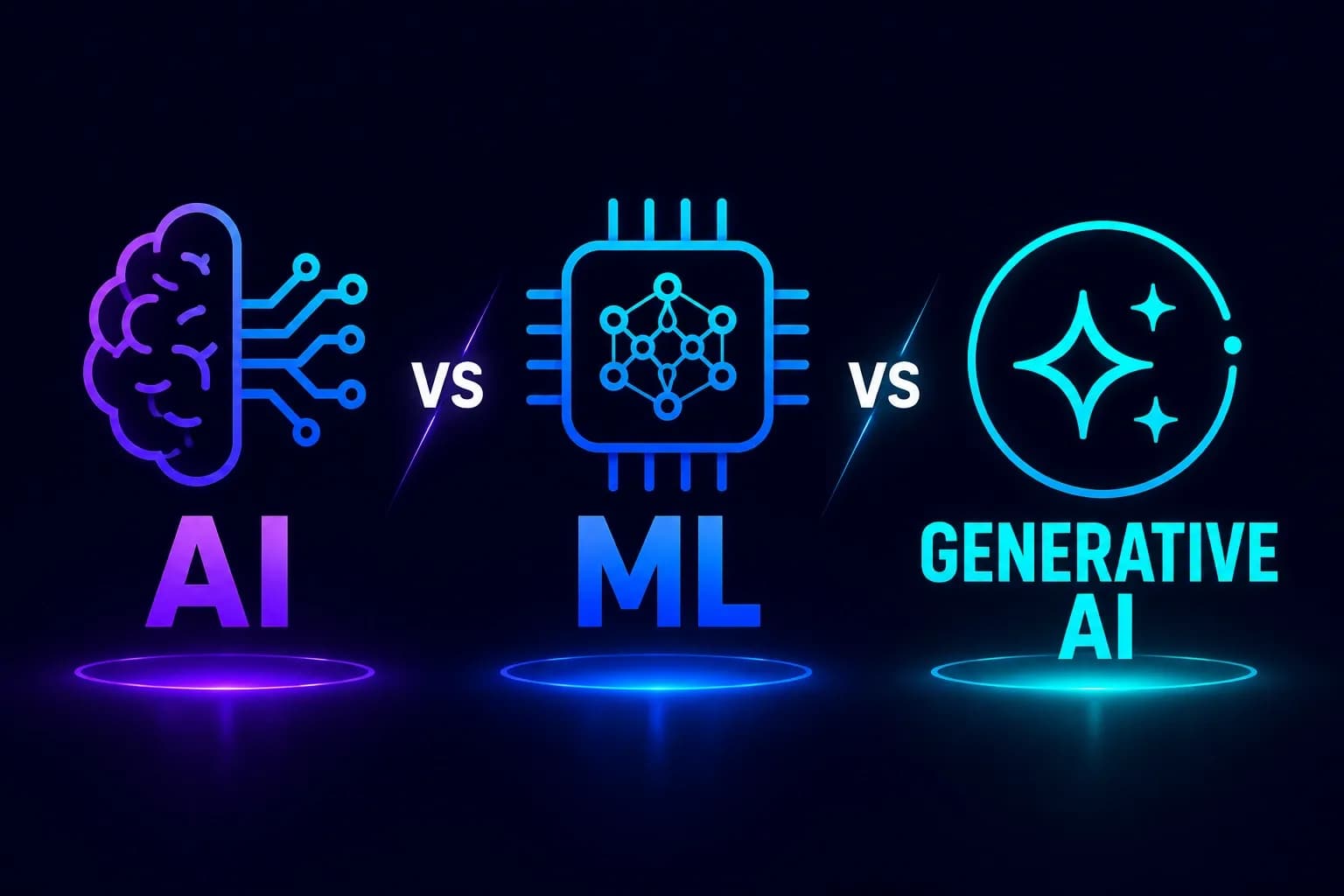
If you have been following the AI space recently, you have probably come across terms like "generative AI," "traditional AI," "machine learning," and "deep learning" used almost interchangeably. But they are not the same thing. Each one represents a different layer of artificial intelligence, and confusing them can lead to poor career decisions, wrong tool choices, and missed opportunities.
In this guide, you will learn exactly what each term means, how they relate to each other, where they differ, and which one you should focus on learning depending on your career goals.
What Is Traditional AI? A Simple Definition
Traditional AI (also called narrow AI or analytical AI) refers to systems designed to perform specific tasks by following rules or learning patterns from data. These systems analyse, classify, and predict. But they do not create anything new.
Here is an analogy: if generative AI is an author who writes new books, traditional AI is a librarian who organises, finds, and sorts books that already exist.
Examples of Traditional AI in Everyday Life
• Email spam filters that classify messages as spam or not spam
• Netflix recommendations that predict what you might enjoy watching
• Fraud detection systems in banking that flag suspicious transactions
• Voice assistants like Siri that understand your spoken commands
• Navigation apps that predict the fastest route based on traffic data
Traditional AI has been around for decades and powers most of the intelligent systems you already use. It excels at pattern recognition, classification, and prediction within well-defined boundaries.
What Is Machine Learning?
Machine learning (ML) is a method of building AI. Instead of programming explicit rules, you feed data to algorithms and let them learn patterns on their own. Machine learning is the engine that powers both traditional AI and generative AI.
How Machine Learning Works: Step by Step
1. Collect data. Gather labelled examples (for instance, thousands of emails marked "spam" or "not spam").
2. Choose an algorithm. Select a model type such as a decision tree, support vector machine, or neural network.
3. Train the model. The algorithm processes the data and finds patterns.
4. Evaluate performance. Test the model's accuracy on data it has never seen before.
5. Deploy. Use the trained model to make predictions on new, real-world data.
Machine learning includes several sub-fields: supervised learning, unsupervised learning, reinforcement learning, and deep learning. Deep learning, which uses neural networks with many layers, is what made generative AI possible.
? Learn how models work under the hood: How Do Large Language Models (LLMs) Work? [G3]
What Is Generative AI?
Generative AI is the subset of machine learning that creates new content rather than simply analysing existing data. It uses deep learning architectures (specifically transformers) to produce text, images, music, code, and video that did not exist before.
? New to the concept?: Read What is Generative AI? A Complete Beginner's Guide [G1]
What Makes Generative AI Different
Traditional ML asks: "What category does this belong to?"
Generative AI asks: "What new content should I create based on what I have learned?"
When you ask ChatGPT to write an email, use Claude to summarise a research paper, or generate an image with Midjourney, that is generative AI at work. The model is not retrieving a stored answer. It is constructing a new response by predicting the most likely sequence of words or pixels based on patterns it learned during training.
In Simple Words
Generative AI = AI that creates. You give it a prompt (a question, instruction, or idea), and it generates something new: a paragraph of text, a piece of code, an image, or even a video. Traditional AI analyses what already exists. Generative AI creates what did not exist before.
Generative AI vs Traditional AI vs Machine Learning: Comparison Table
This table is the simplest way to see the core differences at a glance.
| Feature | Traditional AI | Machine Learning | Generative AI |
|---|---|---|---|
| Primary Function | Classifies, predicts, automates rules | Learns patterns from data | Creates new content |
| Output Type | Decisions, labels, scores | Predictions, clusters, recommendations | Text, images, code, audio, video |
| Approach | Rule-based or trained models | Trained on data | Trained on massive datasets with transformers |
| Examples | Spam filters, chess engines | Recommendation engines, fraud detection | ChatGPT, Claude, Midjourney, DALL-E |
| Data Needed | Structured, task-specific | Moderate to large datasets | Enormous datasets (billions of data points) |
| Creates New Content? | No | No | Yes |
| Key Technique | If-then rules, decision trees | Regression, classification, clustering | Transformer architecture, diffusion models |
| User Interaction | Operates behind the scenes | Automated predictions | Direct conversation via prompts |
| Human Analogy | A referee making calls | A student studying for exams | An artist creating original work |
The key takeaway: Traditional AI answers the question "What is this?" (classification). Generative AI answers the question "What could this be?" (creation). Machine learning is the method that powers both.
How They All Relate: The AI Family Tree
Think of it as nested circles, where each layer sits inside the one above it:
• Artificial Intelligence is the broadest category. It covers any system that mimics human intelligence.
• Machine Learning sits inside AI. It is one way of achieving artificial intelligence by learning from data instead of following hardcoded rules.
• Deep Learning sits inside ML. It uses multi-layered neural networks to learn complex patterns.
• Generative AI sits inside deep learning. It uses deep learning specifically to generate new, original outputs.
In simple words:
All generative AI is machine learning, and all machine learning is AI. But not all AI is machine learning, and not all machine learning is generative.
When to Use What: A Practical Decision Guide
Choosing the right approach depends on the problem you are trying to solve. Here is a quick reference:
| Problem Type | Best Approach | Example |
|---|---|---|
| Classify emails as spam | Traditional ML | Gmail spam filter |
| Recommend products to users | Machine Learning | Amazon recommendations |
| Detect fraud in transactions | Machine Learning | Banking fraud systems |
| Write marketing copy | Generative AI | ChatGPT, Claude |
| Generate product images | Generative AI | Midjourney, DALL-E |
| Build a document Q&A chatbot | Generative AI + RAG | LangChain + vector database |
| Automate multi-step workflows | Agentic AI | AI agents using CrewAI |
? Explore further: 10 Real-World Applications of Generative AI Across Industries [G4]
Is Deep Learning the Same as Generative AI?
No. Deep learning is a technique. It refers to neural networks with multiple layers. Generative AI is an application of deep learning.
Deep learning can be used for non-generative tasks too. Image recognition (where a system identifies a cat in a photo) uses deep learning but does not generate anything new. Self-driving car perception systems use deep learning to classify objects on the road, and that is also not generative.
Generative AI specifically uses deep learning architectures like transformers (for text) and diffusion models (for images) to produce original content that did not exist before.
Real-World Examples to Make It Click
The best way to understand these differences is through concrete scenarios. Here is how all three layers of AI work together in real organisations.
Scenario 1: A Hospital
• Traditional AI flags an X-ray as "abnormal" (classification).
• Machine Learning predicts a patient's risk of readmission based on historical data.
• Generative AI drafts a detailed radiology report from the X-ray findings.
Scenario 2: An E-Commerce Company
• Traditional AI filters out fraudulent transactions.
• Machine Learning recommends products based on browsing history.
• Generative AI writes personalised product descriptions and generates marketing images.
Scenario 3: A Law Firm
• Traditional AI searches case databases for relevant precedents.
• Machine Learning predicts case outcomes based on historical rulings.
• Generative AI drafts contract summaries, reviews clauses, and generates first drafts of legal documents.
Which One Should You Learn in 2026?
This depends on your career goals and where you want to work:
• If you want to build predictive models, focus on machine learning fundamentals like regression, classification, Python, and scikit-learn.
• If you want to work with AI applications in 2026, generative AI is where the demand is exploding. Roles like prompt engineer, GenAI developer, and AI agent builder are growing at 40% year-over-year in India.
• If you want a comprehensive AI career, learn both. Understanding ML foundations makes you a stronger generative AI practitioner.
The professionals who stand out in 2026 are those who understand the full picture: how ML works under the hood, why traditional AI still matters for many use cases, and how generative AI is transforming what is possible.
? Career deep dive: Generative AI Career Guide: Roles, Skills, and Salaries in India [G19]
Want to Go from Understanding to Building?
If this comparison helped clarify the AI landscape for you, the next step is moving from understanding to actually building AI applications. A structured, project-based learning path can take you from zero to deploying production-ready AI systems in just 16 weeks.
Our Generative AI Course covers everything from Python basics to building RAG systems, AI agents, and fine-tuned models. It is designed for both non-coders and experienced developers, with 8+ portfolio projects, 100% live instruction, and career support.
Frequently Asked Questions
Below are the most commonly asked questions about the differences between generative AI, traditional AI, and machine learning, structured for quick answers.
What is the difference between generative AI and AI?
AI (artificial intelligence) is the broad field of creating intelligent systems. Generative AI is a specific type of AI that creates new content like text, images, and code. Think of AI as the entire field of medicine, and generative AI as a specialisation within it, like surgery.
How is GenAI different from ML?
Machine learning is a method of teaching computers to learn from data. Generative AI uses machine learning (specifically deep learning) but goes further. Instead of just making predictions, it generates entirely new outputs. ML predicts; GenAI creates.
Is deep learning the same as generative AI?
No. Deep learning is a technique that uses multi-layered neural networks. Generative AI is one application of deep learning. Deep learning is also used for non-generative tasks like image recognition and fraud detection.
Is ChatGPT generative AI or machine learning?
ChatGPT is both. It is a generative AI application built using machine learning techniques, specifically deep learning with transformer architecture. It was trained using ML methods and produces generative outputs.
Which should I learn first, ML or generative AI?
If your goal is to get into AI quickly and work with modern tools, start with generative AI fundamentals and prompt engineering. You can learn ML concepts alongside or afterward. Many successful GenAI practitioners learned generative AI first and deepened their ML knowledge over time.
Continue Your Learning Journey
This guide is part of a series. Here is what to read next based on where you want to go:
? Go deeper on how models work: How Do Large Language Models (LLMs) Work? [G3]
? Compare specific models: ChatGPT vs Claude vs Gemini vs Llama: Which AI Model Should You Learn? [G8]
? See real-world use cases: 10 Real-World Applications of Generative AI [G4]
? Start your learning path: How to Learn Generative AI from Scratch: Complete Roadmap [G16]
Start Your Career in AI Today
Join learners who transformed their careers with our industry-aligned Gen AI program